The tennis return of serve is the second most important shot in the game — and the most neglected in practice. You hit it in half of every game you play, yet most players spend very little time developing it deliberately. This guide covers positioning, split step timing, preparation, setup and swing mechanics — written by Randy Reynolds, certified tennis instructor and director of Tennis Nation at Reno Tennis Center.
Andre Agassi had one of the greatest tennis returns of serve of all time and is a great player to emulate and learn from. The biggest mistake players make on the return — myself included — is not practicing it enough. The only way to develop it into an effective weapon is consistent, deliberate practice focused on doing the fundamentals correctly.
Where to Stand for the Tennis Return of Serve
Imagine a string tied from your opponent’s racquet extending over the net into your service box — one string down the center T, one out wide. Stand in the center of those two points to cover both options equally. From there, adjust based on your style of play and your opponent’s tendencies.
Attacking players — stand as close as possible while still having enough time to react:
- Cuts off serve angles
- Better opportunity to handle spin serves moving away
- Takes the ball earlier, dictating play sooner
Baseliners and clay court specialists — standing further back may work better:
- More reaction time on fast serves
- Higher percentage of returns making it back
- Trades earlier position for consistency and rally length
The standard starting position is approximately three feet behind the baseline. Be open to adjusting during the match if your position is not working.
Tennis Return of Serve: Preparation
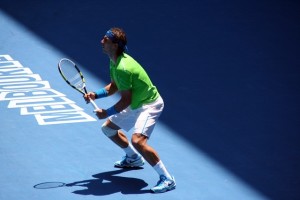
The ready position for the return is the same athletic stance used everywhere on the court: feet shoulder width apart, weight on the balls of your feet, body loose and ready to react.
Stay Loose and Energetic
Being light and loose is critical on the return of serve. Key habits:
- Bounce lightly on the balls of your feet before the serve — many professionals do this continuously
- Keep upper body and hands loose — tension reduces racquet head speed at contact
- Stay energetic between points — a static, flat-footed stance slows your reaction time significantly
Focus on the Ball
Track the ball from the start of your opponent’s service motion. Key cues to read:
- Toss location — tells you the type of serve coming
- Racquet contact angle — reveals direction and spin
- Ball over the opponent’s head — typically signals a topspin or kick serve
Once the serve is four feet in front of you, stop tracking and keep your head still and level through contact. Head movement at this point changes racquet head elevation and causes miss-hits — the ball is moving too fast to track all the way to the strings anyway.
Reacting to the Ball
The sequence for reacting to the serve:
- Step forward as your opponent winds up — generates forward momentum
- Split step — time it so you are in the air or just landing as the server makes contact
- Land loaded — weight in your legs, ready to push off explosively in either direction
Pro Tip: Timing the Forward Step
Every server has a different motion — some longer like Pete Sampras, some shorter like Andy Roddick. Adjust your forward step timing based on who you are facing. The goal is always the same: be in the air or landing your split step exactly as the server contacts the ball.
Tennis Return of Serve: Setup
Once you land the split step and recognize the direction:
- Turn your hips and step out to the ball with your outside foot
- The hip turn naturally rotates your shoulders and creates your backswing
- Backswing stays short — no loop, no full takeback like a groundstroke
- Movement to the ball is forward and diagonal — stepping across the body is acceptable on hard serves out of necessity
Tennis Return of Serve: Swing Mechanics

As you step toward the ball, swing the racquet forward to make contact simultaneously. Like the forehand and backhand:
- Contact point — out in front of the body
- Follow through — finishes around the opposite side of the body
- Head stays still through contact — do not look up to see where the ball is going
Pro Tip: Keep the Backswing Short
Players who practice groundstrokes regularly develop a habit of taking a full backswing — this does not work on the return. Focus on keeping your backswing as compact as possible. Think of blocking the ball back with a short, controlled swing rather than swinging through it like a groundstroke.
Tennis Return of Serve: Best Practice Tip
When splitting forward for the return, allow your elbows to come forward off your body slightly — resting out in front of your core rather than tucked against your sides. This naturally limits your backswing when you rotate your shoulders and hips. Try it out.
For more free technique guides visit our tennis technique library.
Frequently Asked Questions About the Tennis Return of Serve
Where should I stand when returning serve?
The standard position is approximately three feet behind the baseline, centered between the two most common serve locations — down the T and out wide. Attacking players typically stand closer to cut off angles and take the ball earlier. Baseliners may stand further back for more reaction time. The key is to adjust during the match based on what is and is not working.
How do I time my split step on the return of serve?
Take a small step forward as your opponent begins their service motion to generate momentum, then time your split step so you are in the air or just landing as your opponent makes contact with the ball. Because you cannot know the direction of the serve until the ball leaves the strings, you want to land your split step at that exact moment — weight loaded, ready to push off explosively in either direction.
Why is my return of serve inconsistent?
The most common cause is a backswing that is too long. Players who practice groundstrokes regularly develop a habit of taking a full loop — which does not work on the return due to limited reaction time. Keep your backswing as compact as possible. The second most common cause is head movement at contact — keep your head still and level through the hit.
I want to turn my return into a weapon.
The return of serve is the most underpracticed shot in recreational tennis. Work with Randy at Reno Tennis Center and start putting pressure on your opponents from the very first ball of every game.
Does the returner have to stand behind the baseline for the serve?
No, the returner can stand anywhere they want, however must be behind the service line and allow the ball to bounce before returning.
Can you volley the ball when returning the seeve?