The neutral stance forehand is the foundation of consistent, powerful ball-striking — particularly when attacking short balls or moving forward into the court. While the modern game emphasizes open stances for lateral movement, the neutral stance delivers superior weight transfer and linear momentum that no other forehand stance can match. This guide covers every phase: grip, preparation, setup, swing and follow through — written by Randy Reynolds, certified tennis instructor and director of Tennis Nation at Reno Tennis Center.
Two Types of Forehands
Today there are two main forehand stances in tennis:
- Neutral stance forehand — traditional, superior weight transfer, ideal for balls in the middle or when moving forward
- Open stance forehand — modern, better recovery when pulled wide or on the run
Both are used by professional players today and both can be effective at all levels of play. I recommend using both — choosing based on the ball received and your court position.
Which Forehand Stance is Best?
When to Use the Neutral Stance Forehand
Use the neutral stance in these situations:
- Ball is around the middle of the court
- You are moving forward — your momentum is already linear, so the load takes less time
- Short balls and approach shots — you can take the ball earlier, taking time away from your opponent
When to Use the Open Stance Forehand
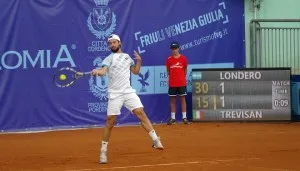
The open stance forehand is the modern choice when pulled wide or on the run.
Use the open stance when:
- Pulled wide off the court or on the run
- You need to recover quickly back to the center after the shot
Players who use the neutral stance on the run often cannot set their feet perpendicular to the baseline — limiting shoulder and hip rotation, and therefore both power and recovery.
Neutral Stance Forehand: Tennis Grip
Three forehand grips to choose from:
- Eastern grip — easiest to learn, great for beginners and attacking players
- Semi-western grip — most popular on tour, best balance of power and topspin
- Western grip — extreme topspin, favored by clay-court specialists
The majority of professional players use the semi-western grip. It generates power and topspin efficiently and handles both low and high balls well. To find it: lay your racquet flat on the ground and place your palm face-down on the grip.
There is wiggle room — my forehand grip sits between the eastern and semi-western, and that is perfectly fine. For a full breakdown visit the complete tennis grip guide.
Neutral Stance Forehand: Preparation
Footwork is the foundation of solid preparation. Key checkpoints:
- Split step timing — feet hit the ground at the exact moment you recognize the direction of your opponent’s shot
- Shoulder and hip rotation — begins as you react, allowing the racquet to naturally start its takeback
- Proper distance — focus on keeping space between you and the ball as you run
- Ball height — ideally rises or drops to around waist high before you set your feet
- Adjustment steps — take as many as necessary before planting
Neutral Stance Forehand: Set Up
With proper distance and ball at waist height, set your feet:
- Right foot (right-handed) placed parallel to the baseline
- Body weight loaded onto the right foot
- Shoulders and hips fully turned — opponent sees your left shoulder blade and left hip
- Bend the right knee slightly as if beginning to sit down — this loads the weight correctly
- Last step forward with the left leg — transfers weight toward the net
Neutral Stance Forehand: Swing
Key checkpoints for the swing:
- Hitting elbow rises slightly up and away from the body on the backswing
- Non-hitting hand extends out at chest-to-shoulder height — closes and loads the left shoulder
- Racquet head drops from the top of the backswing — palm facing down, butt cap pointing toward the net
- Low to high swing path — approaches from below to generate topspin
- Hand stays loose throughout — tension kills racquet head speed
Think of loading your shoulders and hips like loading up to throw a medicine ball — arms extended, back straight, tossing with your whole body rotating through.
Neutral Stance Forehand: Contact and Follow Through

At the finish, the hitting hand should end over the left shoulder at around shoulder height.
The goal of every phase is solid contact with full weight transfer:
- Contact point: slightly in front of your left hip (right-handed players)
- Sensation at contact: ball should feel light and travel cleanly toward your target
- Hand stays loose at contact — this is what generates racquet head speed
- Follow through: hitting hand finishes over the left shoulder at around shoulder height
For more stroke guides visit our complete tennis technique library, and check out the open stance forehand guide to see how the two stances compare.
Frequently Asked Questions About the Neutral Stance Forehand
When should I use a neutral stance forehand instead of an open stance?
Use the neutral stance when the ball comes to the middle of the court or when you are already moving forward. It allows for superior linear weight transfer — ideal for approach shots and short balls where your momentum is already moving toward the net. Use the open stance when pulled wide or on the run, where recovering quickly to the center is the priority.
What grip should I use for the neutral stance forehand?
The semi-western grip is the most commonly recommended for the forehand at all levels — including most professional players. It generates both power and topspin efficiently and handles a wide range of ball heights. To find it, lay your racquet flat and place your palm face-down on the grip. There is wiggle room — many players naturally sit between the eastern and semi-western, which is perfectly fine.
What is the correct contact point for the neutral stance forehand?
The ideal contact point is slightly in front of your front hip — for a right-handed player, just ahead of the left hip. This allows your hip and shoulder rotation to fully transfer through the ball. Contacting too late — level with or behind the hip — cuts off rotation and produces weak, inconsistent shots. A useful check: if the ball feels light and travels cleanly to your target, your timing and contact point are correct.
I want to develop a consistent, powerful forehand.
Book a private lesson at Reno Tennis Center and work with Randy Reynolds on your stance, grip and swing mechanics — building the forehand that holds up under match pressure.
Book a Lesson at Reno Tennis Center →
Leave a Reply