Most recreational players rely on habits instead of strategy — hitting to the same spots, using the same patterns, wondering why results don’t improve. In this statistics-driven guide, Randy Reynolds — certified tennis instructor and director of Tennis Nation at Reno Tennis Center — breaks down the serve patterns, return tactics, shot selection zones and set plays that the best players in the world actually use. Data from Craig O’Shannessy, former strategy analyst for Novak Djokovic. To apply these patterns on court with expert guidance, explore our tennis clinics at Reno Tennis Center.
Introduction
When talking tennis with my peers and fellow tennis coaches it became evident that we all had our own preferences on tennis singles strategy. None of us had the data to suggest which approach would be ideal. So I researched and found many valuable resources — one of which was from Craig O’Shannessy, formerly on the strategy team for Novak Djokovic, known for sharing tennis statistics and patterns that apply to all levels of play.
You will find a tennis court template labeled with numbers and letters at the end of the article. Refer to it when serve locations and patterns of play are mentioned.
Start With These Three Questions
- Who am I? Know your strengths and weaknesses.
- Who is my opponent? Figure out their strengths and weaknesses.
- Who is the best? Know what the top players in the world are doing — and copy their patterns.
Based on these findings, build a game plan for the first 4 shots. Focus on forcing errors. It is easier to make the opponent play bad than to play great yourself.
- Primary patterns: ~75% of the time — use to get up in the score
- Secondary patterns: ~25% of the time — use when the score doesn’t press the situation
8 Ways to Force an Error
*Depth*, Consistency, Direction, Height, Spin, Power, Court Position, Time.
Tennis Singles Strategy Win Percentages
| Position | Win % | Notes |
|---|---|---|
| Baseline | 46% | Lowest win rate |
| Approaching | 66% → 71% | Heavy forehand to backhand behind player increases to 71% |
| Serve and Volley | 69% | Ideal first volley is behind the player |
Serve Patterns
- Primary 1st serve pattern: out wide to zones 1 and 8
- Primary 2nd serve pattern: body-backhand jammer to zones 3 and 7, and to the backhand
*The 1st service game should have a greater percentage of serves to the body than any other game — this increases your 1st serve percentage in early.
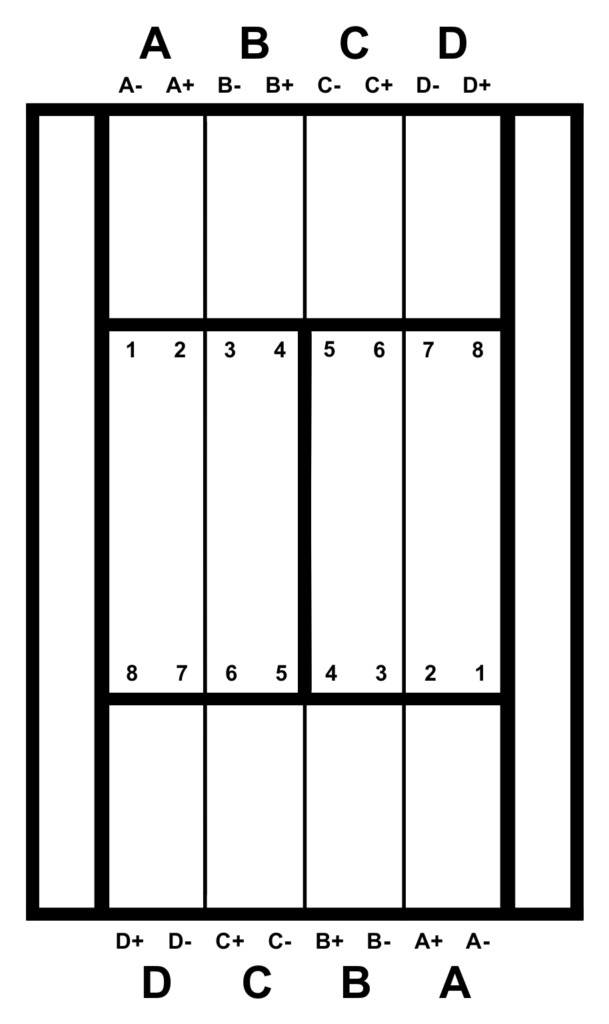
Reference this court diagram when planning your serve patterns — zones 1 and 8 are your primary targets.
Serve Goals
| Metric | Target % |
|---|---|
| 1st serve in | 60% |
| 1st serve points won | 70% |
| 2nd serve points won | 50% |
| Breakpoints saved | 60% |
| Service games won | 80% |
Return Patterns
- 1st serve return: On the defense — return deep down the middle of the court
- 2nd serve return: On the offense — step up and take the serve early (Murray) or run around it and hit a forehand (Nadal). Big shots go to big targets.
*70% (men) and 75% (women) of returns come back.
Passing Shots
- Primary: crosscourt roll
- Secondary: down the line
Zones in Tennis to Guide Shot Selection
| Zone | Position | Shot Strategy |
|---|---|---|
| Defensive | 6+ feet beyond baseline | 6+ feet above the net — depth, recovery time |
| Neutral | Beyond baseline | 3–6 feet above net with topspin — push opponent back |
| Attacking | Inside baseline | Within 3 feet above net — prevent shots sailing long |
| Kill | Around service line | Same principles as attacking zone |
Playbook for Tennis Singles Strategy
The 2-1
- First shot deep to C+ — push the opponent back
- Second shot wide to D — open up the court
- Third shot to A — the unspectacular winner
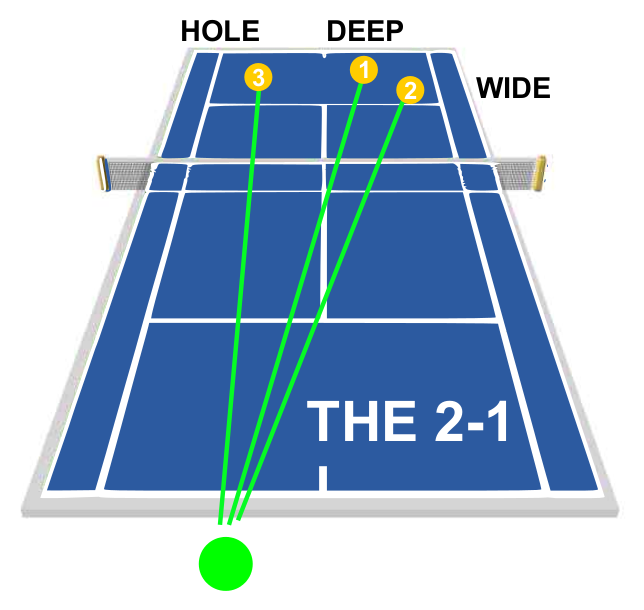
The 2-1: push deep, open wide, finish with the unspectacular winner.
Watch the 2-1 and Backhand Cage patterns in action.
The Backhand Cage
Your forehand (sword) vs the opponent’s backhand (shield). Make your opponent hit 4 backhands in a row.
- *If your opponent is using this pattern against you — attack their forehand first.
- *To counter: hit the backhand down the line without giving up court position.
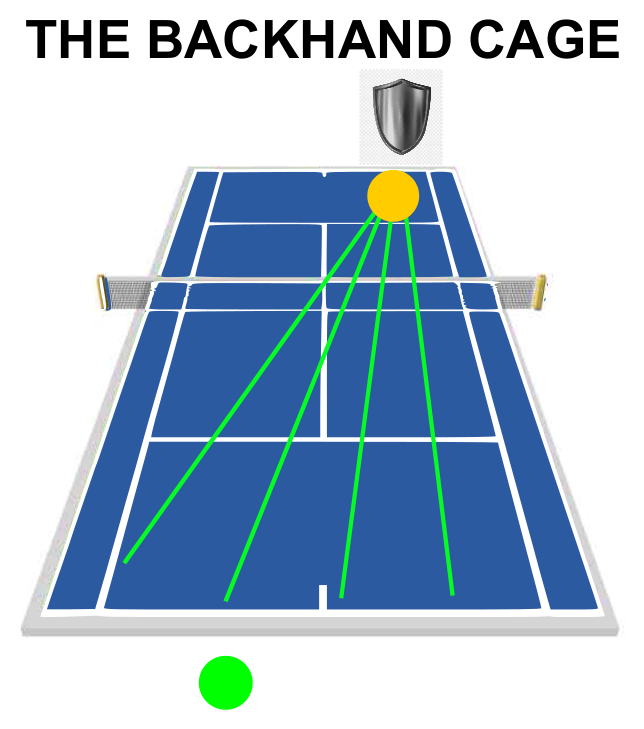
The Backhand Cage: use your forehand to force 4 consecutive backhands from your opponent.
Serve + 1 Forehand
- Hit the forehand instead of the backhand — 2:1 winner ratio
- Attack the same side twice (Deuce or Ad) — causes the opponent to freeze and removes anticipation
Number of Shots per Point
| Shots | Type | % of Points |
|---|---|---|
| 1–4 | First Strike | 70% |
| 5–8 | Patterns | 20% |
| 9+ | Extended Rallies | 10% |
*Takeaway: Spend more time on the serve and return — serve +1 and return +1.
More Keys for Success
- The best players in the world win 55% of points — be prepared to lose 45%
- The match is played during the point and between the points
- One point can change everything
- 80% of points end in errors — chase the 80% by making your opponent uncomfortable
- Hit run-around forehands — forehands produce 2x more winners than backhands
- C+ is where players stand the most — know it and use it
- Spend 80% of time developing strengths and 20% minimizing weaknesses
- Play more than you practice
Tennis Singles Strategy Framework
Refer to this court diagram when formulating your singles strategy and patterns of play before your matches. If you enjoyed this article I know you will love the tennis doubles strategy and positioning post as well.

Use this court template to map out your serve patterns, return targets and set plays.
For more free strategy guides visit our tennis strategy library.
Frequently Asked Questions About Tennis Singles Strategy
What is the most effective serve pattern in tennis singles?
The most effective primary first serve pattern is out wide — targeting zones 1 (deuce) and 8 (ad). For second serves, the body-backhand jammer to zones 3 and 7 is the highest-percentage option — it limits the returner’s ability to step into an aggressive swing. The first service game is where you should serve to the body more than any other game — getting first serve percentage up early sets the tone for the entire match.
Why do approach shots win more points than staying at the baseline?
Players who approach the net win 66% of points on average — compared to just 46% from the baseline. That number climbs to 71% when the approach is a heavy forehand directed at the opponent’s backhand landing behind the player. The serve and volley is even more effective at 69%. Moving forward puts pressure on the opponent, reduces their reaction time, and increases court coverage. Staying back is the lower-percentage choice in most situations.
What is the 2-1 pattern and when should you use it?
The 2-1 is a three-shot construction pattern: first shot deep to C+ to push the opponent back, second shot wide to D to open the court, third shot to zone A for the unspectacular winner — placed into open space rather than hit for a flashy winner. Use it as a primary pattern ~75% of the time, especially when building a lead. It relies on court geometry rather than pace or power — making it reliable at every level.
I want a game plan that actually works on match day.
Join a singles clinic at Reno Tennis Center and work with Randy Reynolds on the patterns, positioning and tactics that win matches at every level.
Great info for a relative beginner like me. Thank you
Superb info.! You and Gilbert give me more victories than i in all my life!
Thanks Pedro, keep those wins coming!
It is good advice for a beginner.
Agreed, thanks Frantz!
Best description of court strategy and stats I have ever seen. Thanks!
Thanks John I appreciate it!
A few questions please.
1. I know from the pros the serve to 1 and 8 are popular but based on number of serves going there vs body and backhand if they levelled which one has more success rates.