Most doubles teams lose not because of poor strokes, but because of poor positioning and decision-making. In this data-driven guide, Randy Reynolds — certified tennis instructor and director of Tennis Nation at Reno Tennis Center — breaks down the court positioning, serve patterns, volley targets and set plays that winning doubles teams actually use. Statistics from a USPTA presentation by Craig O’Shannessy, former strategy analyst for Novak Djokovic. To apply these concepts on court with expert coaching, explore our tennis clinics at Reno Tennis Center.
Introduction
Playing tennis with different doubles partners can be frustrating because not everyone knows tennis doubles strategy. Rather than relying solely on years of experience, I researched the statistics that determine patterns of winning doubles — and found a USPTA talk by Craig O’Shannessy, formerly on the strategy team for Novak Djokovic, known for using data to guide doubles strategy and positioning.
You will find a tennis court template labeled with numbers and letters at the end of the article. Refer to it when serve locations and patterns of play are mentioned.
Doubles Statistics to Drive Strategy
| Outcome | Percentage |
|---|---|
| Winners | 41% |
| Forced Errors | 38% |
| Unforced Errors | 21% |
Number of Shots per Point
| Shots | Type | % of Points |
|---|---|---|
| 1–4 | First Strike | 81% |
| 5–8 | Patterns | 17% |
| 9+ | Extended Rallies | 2% |
*Takeaway: Spend more time on the serve and return — serve +1 and return +1. Average rally length is ~3 shots.
Last Shot in Doubles
| Metric | % |
|---|---|
| Up at Net | 68% |
| At the Baseline | 32% |
| By the Server | 64% |
| By the Returner | 36% |
| Winner up at Net | 84% |
| Winner at Baseline | 16% |
| Error up at Net | 49% |
| Error at Baseline | 51% |
Last Shot Winner by Team
| Shot Type | Serving Team | Returning Team |
|---|---|---|
| Volley | 64% | 54% |
| Overhead | 75% | 86% |
| Passing Shot | 35% | 30% |
| Lob | 0% | 29% |
| Ground Stroke | 10% | 4% |
Serve and Return Percentages
| Metric | % |
|---|---|
| 1st Serve % In | 68% |
| 1st Serve Win % | 74% |
| 2nd Serve Win % | 54% |
| Unreturned Serves | 15% |
| Return Winners | 13% |
| Forehand Winners | 17% |
| Backhand Winners | 10% |
Tennis Doubles Strategy
Control the Center Window
The center window is a 9ft wide by 3ft high window centered at the net strap — shaped like an hourglass with the narrow neck at the center of the net.
- Serving team: keep balls in the middle of the court
- Returning team: keep balls wide to create chaos — or hit down the middle to take over the center window
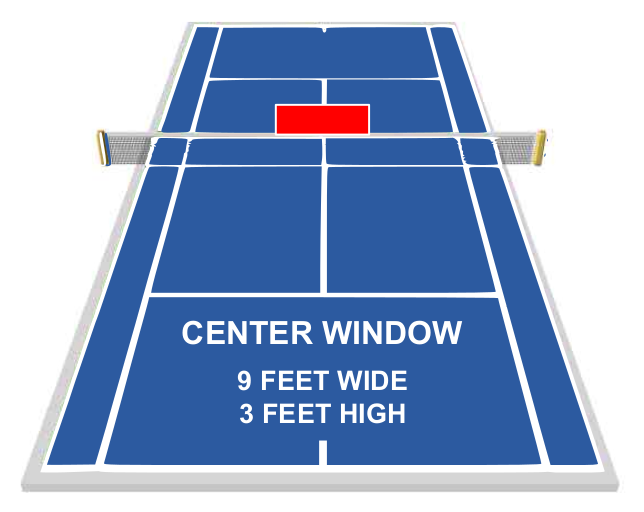
Control the center window and you control the match.
*If you don’t control the center window — stop playing there immediately. Lob and create angles elsewhere.
Tennis Doubles Positioning
Where You Stand Matters
Positioning visually expands and shrinks areas of the court. Ideal positioning:
- Server’s partner: center of the service box
- Returner’s partner: behind the service line at serve location 3 (deuce) and 6 (ad) — buys the returner more reaction time
- Staggered formation: preferred — server positioned at the service line midpoint of the service box (over 2 up equal and 2 back)
- Rubber band rule: when your partner gets pushed back or pulled wide, adjust to protect the middle
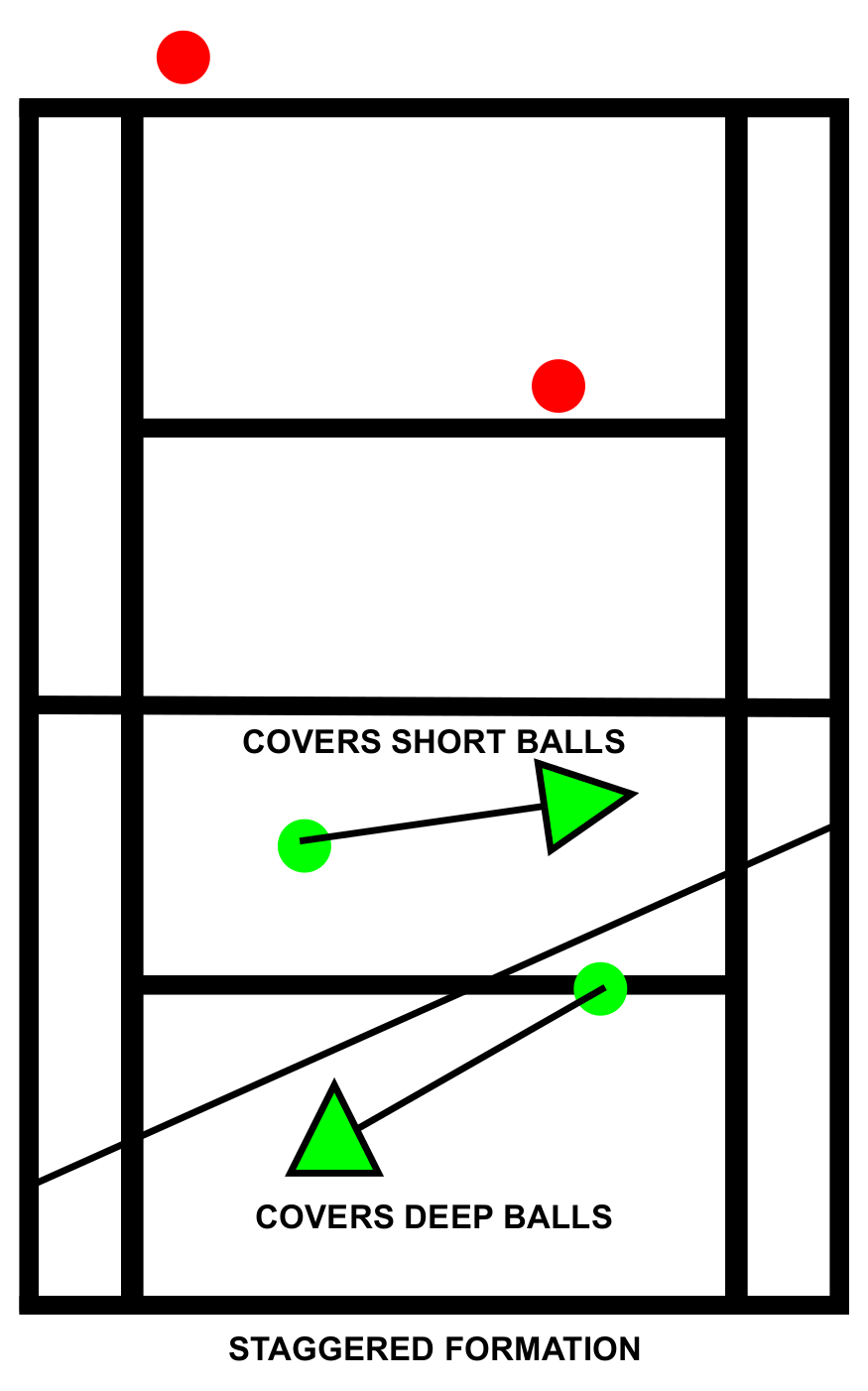
The staggered formation gives your team the best court coverage in doubles.
Where to Look
Eyes forward. Opponents are a mirror. All the information you need is in front of you.
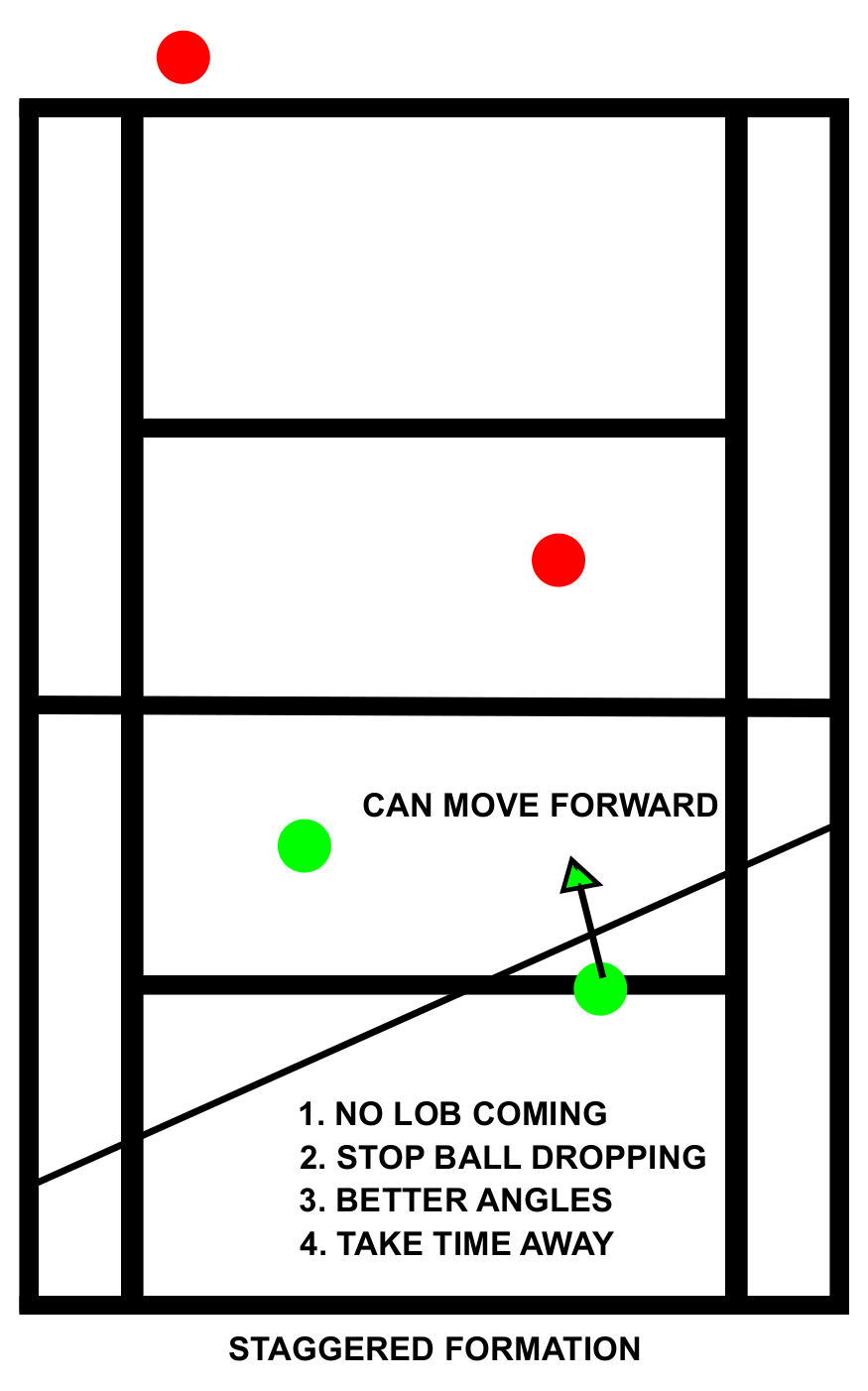
Read your opponents first — all the information you need is in front of you.
Forget the Lines
- Once the serve is hit, most lines vanish
- Teamwork: back player makes the front player look good — like volleyball (back player sets, front player spikes)
- Net player covers: side, front, and middle
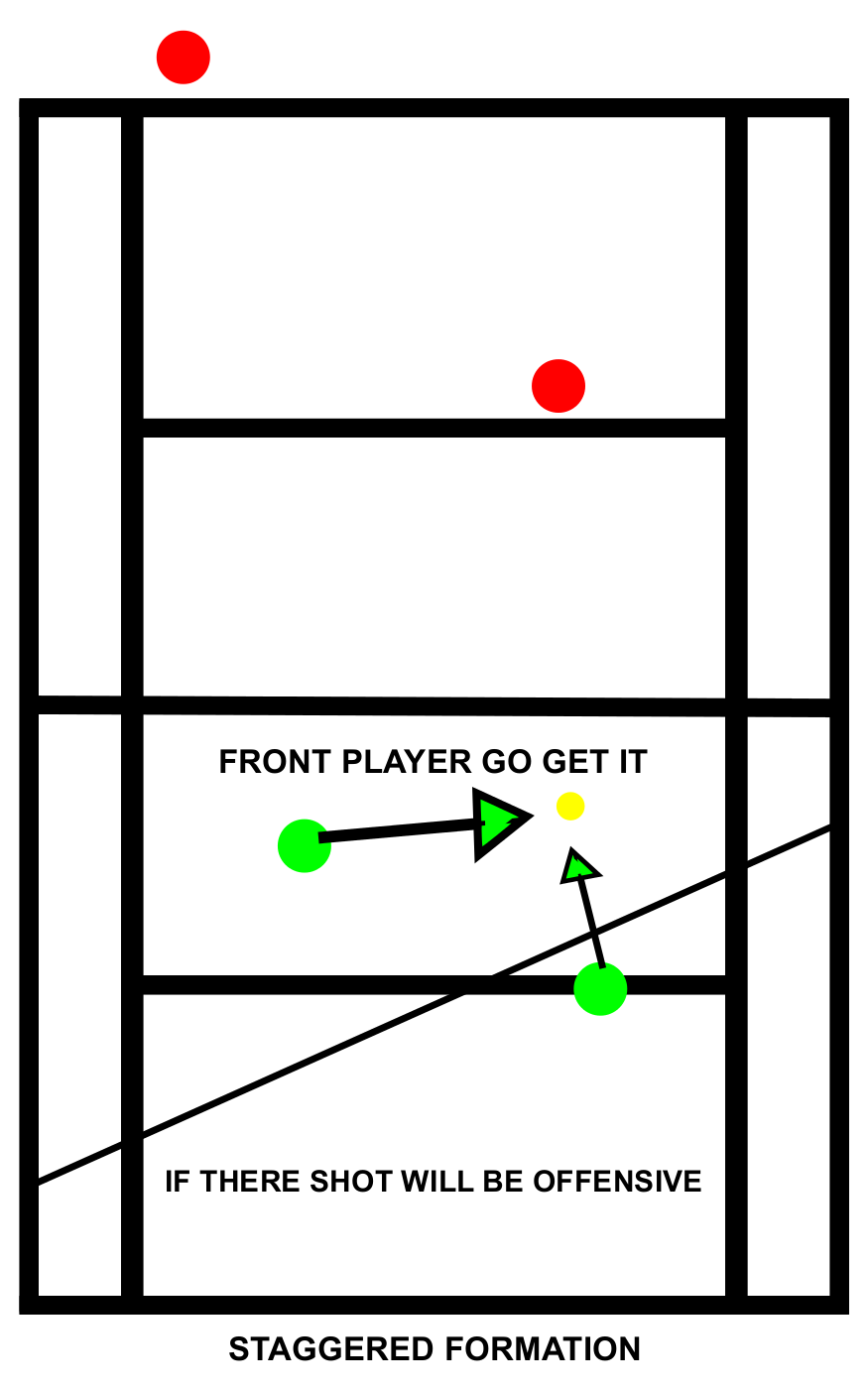
The front player owns the side, front, and middle — go get it.
Don’t Follow the Ball
- Player looks comfortable (balanced, set up, has time) → follow the ball
- Player looks uncomfortable (reaching, off balance, rushed, jammed, lunging) → ball is not going down the line — go center or middle

When your opponent is in trouble, close to the middle — not the line.
Don’t Change Directions
- Don’t create new angles on the court to get hurt with
- Create a 2 on 1 scenario — hockey power play
*Doubles lesson: call out “there’s a change” when the ball changes direction. If the team who changed direction wins the point it counts. If they lose, it’s worth 2 points for the other team. Down the middle and cross court is always fine.
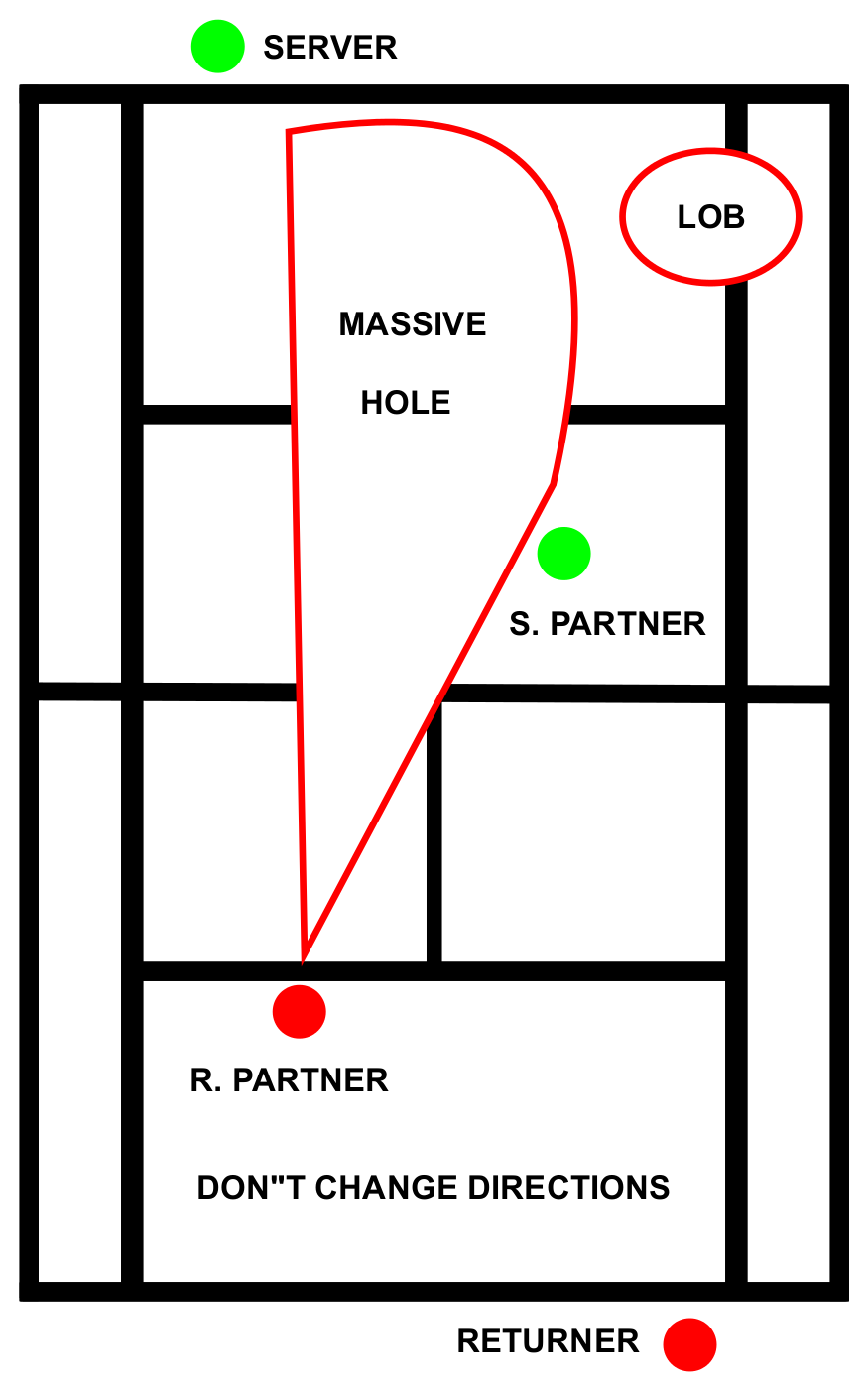
Keep the ball going the same direction — create a 2 on 1 like a hockey power play.
Don’t Cover the Line
- It’s not embarrassing — it’s greatness
- Rule of 3: beat me 3 times and I will respect it
- Front player looks bad → typically the back player’s fault
- Give up at least half of the doubles alley
Tennis Doubles Strategy: Where to Place the Ball
Best Serve Locations
- Deuce primary pattern: 4 & 3 — returner generally has a strong forehand return
- Deuce secondary pattern: 1
- Ad court: find the weakness — the better backhand returner is typically there
Best Return Locations
- Deuce court: server’s feet when serve-volleying, side T, or to B when server stays back
- Ad court: out wide to catch the backhand late, or to side T
Volley Targets
Offensive volleys (server’s partner) — in order of priority:
- Down the middle
- Out wide
- Touch angle
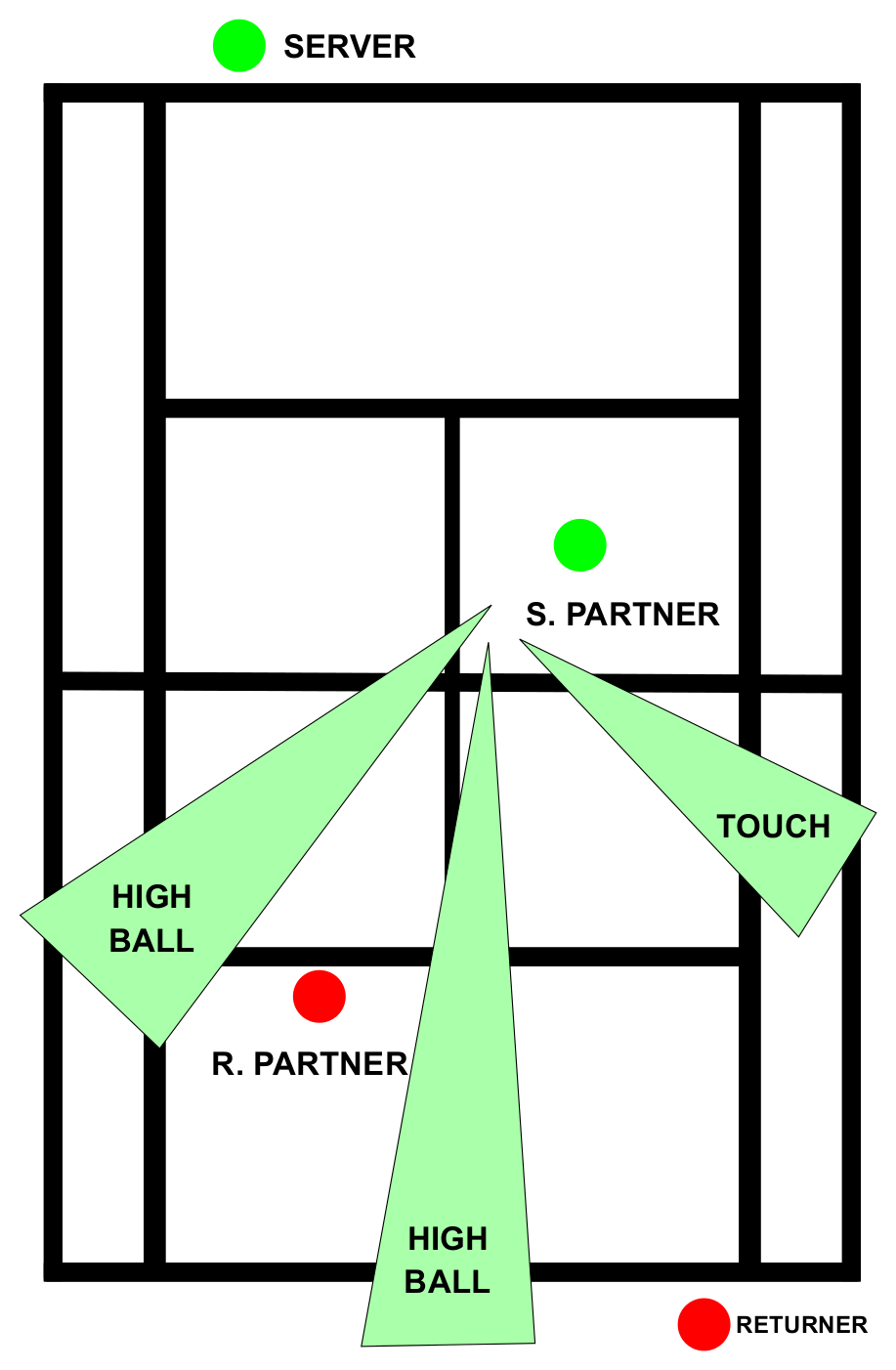
Offensive volley priority: middle first, wide second, touch angle third.
Defensive volleys (server’s partner) — in order of priority:
- Back deep to returner
- Feet of returner’s partner
*Preview the spots before the point starts. Things happen fast. Play it first in your mind.
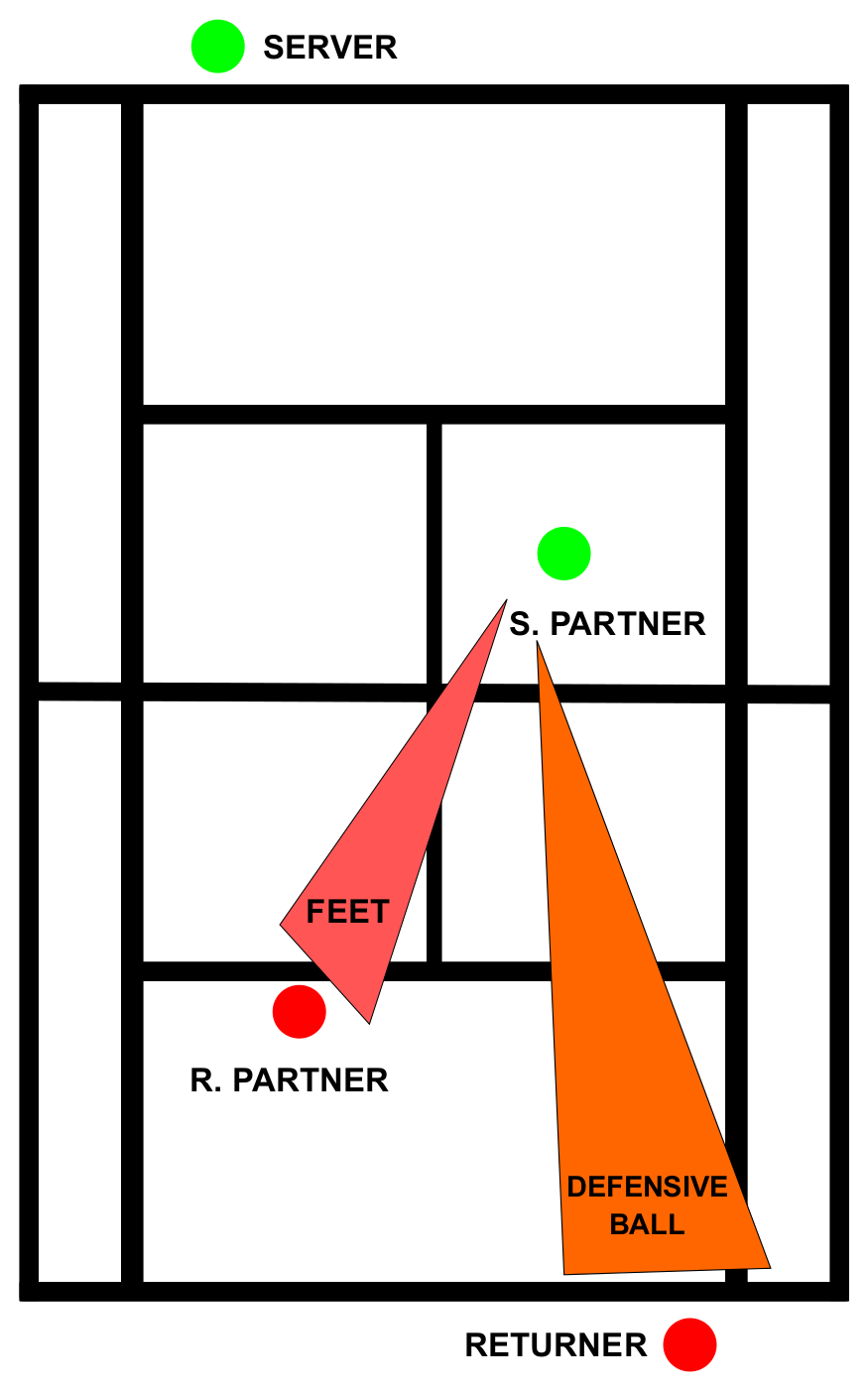
When defending, go deep to the returner or at the feet of the returner’s partner.
Low Middle — The Doubles Default
When in doubt: go low middle. Percentages, confusion, boomerang effect, multiplying opportunities. Rather than going wide or down the line — go low middle.
Tennis Doubles Playbook
The J
The returner’s partner goes forward faking to cover their side — then cuts to the middle right before the server hits the ball.
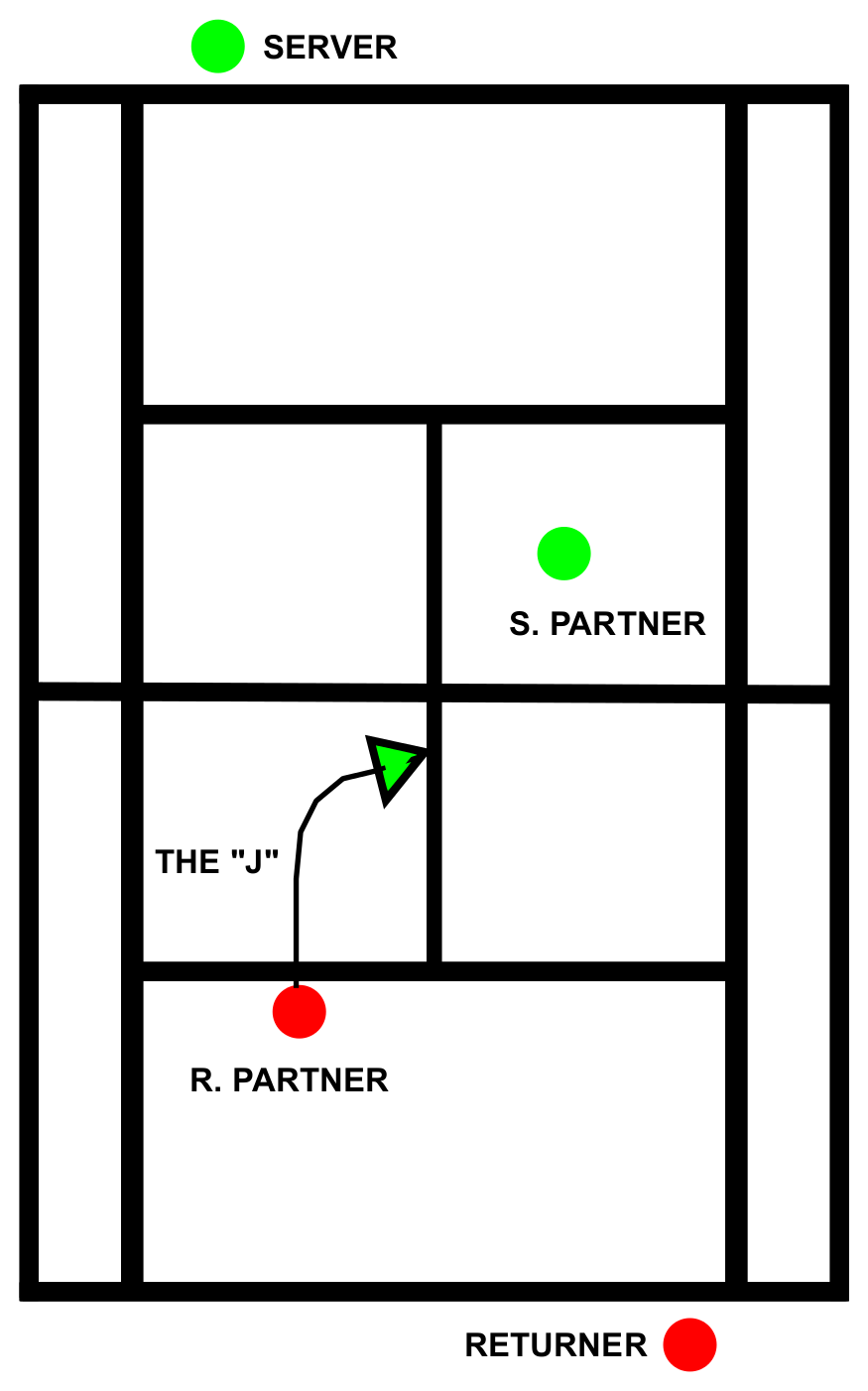
The J: fake the line, cut to the middle at the last moment.
The V
Server’s partner covers more at the net. Start with split steps and go to get the ball. Think about cutting into the net strap.
Reasons to Play Two Back
- Big server
- No center window control
- Slower at net
- Better groundstrokes
- Returner’s partner in trouble
Lob Returns
Good doubles teams use the lob as a weapon and chaos creator. Counter an aggressive server’s partner by going high over their backhand volley.
Serve Formations
Traditional, “I”, Australian — utilize serve formations to make the returner hit the ball where you want it. The Australian formation is most effective on the ad side when the returner has a great crosscourt return.
Returner’s Partner Neutral
- Only cross the service line when on offense
- Focus on the server’s partner
- Defense: back middle (backwards J)
- Offense: J to the middle
Tennis Doubles Strategy Framework
Use the tennis court diagram below to plot your doubles strategy, court positioning and set plays before your matches. It is also a great tool to get your partner on the same page. If you enjoyed this article I know you will love the tennis singles strategy post as well.

Use this court template to map out your serve patterns, return targets and set plays.
For more free strategy guides visit our tennis strategy library.
Frequently Asked Questions About Tennis Doubles Strategy
What is the most important positioning principle in tennis doubles?
The staggered formation is the most effective default positioning in doubles. Rather than playing two up or two back, the server moves to the service line midpoint after serving while their partner holds the net — creating an asymmetric formation that covers the most court. The key concept is the rubber band: when your partner gets pulled wide or pushed back, you adjust to protect the middle. The team that controls the center window wins the majority of points.
Why does doubles data show you should go to net as much as possible?
84% of winners in doubles are hit by the player at the net — compared to just 16% from the baseline. The serving team hits the last shot 64% of the time and they are almost always the team that moved forward. Getting to the net is not just aggressive — it is the statistically correct default position in doubles. With 81% of points ending in 4 shots or fewer, the serve, return and first volley are the three most important shots to practice.
What does “don’t follow the ball” mean in doubles positioning?
It means reading your opponent’s body language rather than reacting to ball direction. Opponent looks comfortable → follow the ball. Opponent looks uncomfortable (rushed, off balance, reaching, jammed) → close toward the middle. The ball is almost certainly not going down the line. This is one of the most common positioning errors in recreational doubles: the net player drifts toward the line when their opponent is in trouble, leaving the entire middle open.
I want to put this doubles strategy into practice.
Join a doubles clinic at Reno Tennis Center and work directly with Randy Reynolds on court positioning, patterns of play, and the set plays that win matches.
Great article-explains everything you need to help your doubles strategy-will be sending a link to this to my doubles players
Regards from Tenerife
Thanks John appreciate it!
Thank you , Good information , Of say knowing your partner is a Big part of communication on the Court
Great article!!
Nicely done. I especially liked the part about the staggered position so that the partner crosscourt from the ball can cover the lob over the more aggressive player who is up at the net.
Such a great article for me and my partner! Thank you!